


EMDR Therapy in Utah
How different would your life be if trauma no longer kept you stuck? Welcome to our safe haven, a place where you're not alone in your journey to overcome Post-Traumatic Stress Disorder (PTSD) and the haunting grip of trauma.

What Is EMDR?

EMDR, Eye Movement Desensitization and Reprocessing, is a structured, research-supported therapy that helps your brain process distressing memories and experiences. It was developed by psychologist Francine Shapiro in 1987 and has since become one of the most widely used trauma treatments worldwide.
The idea behind EMDR is that when something overwhelming happens, your brain sometimes doesn't fully process it the way it processes ordinary memories. The moment stays frozen, so remembering it can feel almost as distressing as living through it the first time. EMDR helps your brain finish that processing, so the memory stays but the emotional charge attached to it doesn't.
The goal isn't to erase what happened. It's to help the memory feel like something that happened then, rather than something you're still reacting to now.
How Does It Work?
How Does It Work?
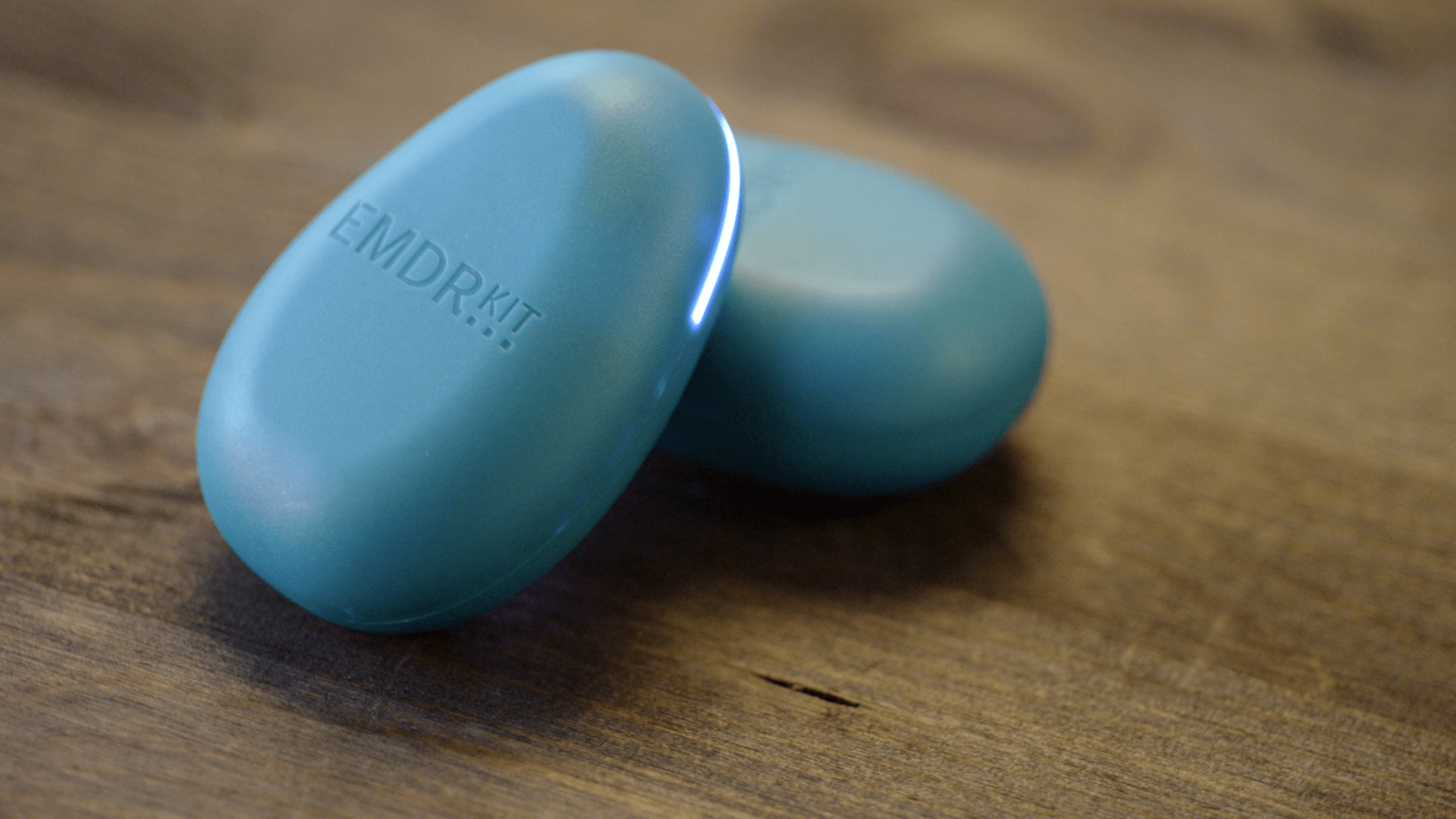
How Does EMDR Work?
EMDR uses a technique called bilateral stimulation, gentle, alternating stimulation of both sides of the brain, often through guided eye movements or handheld pulsators that softly alternate between your hands. This process is thought to mirror what happens naturally during REM sleep, when your brain processes the events of your day.
Your therapist won't ask you to relive every detail out loud. You'll share enough for your therapist to understand what you're working through and help you stay grounded, but you stay in control of what you share and how much. Sessions typically move through a few stages: understanding what's bringing you in, building enough safety and stability to begin processing, and then using bilateral stimulation to help your brain work through what feels stuck.
What EMDR Can Help With
EMDR was originally developed for PTSD, and research continues to support it as an effective treatment for trauma. At Modern Eve, our EMDR-trained therapists use it to help with:
Trauma and PTSD
Distressing or painful memories
Anxiety and panic
Grief and loss
Negative beliefs about yourself that persist even when you know, logically, they aren't true
Stress connected to past experiences that still feels present
If you experience distressing emotional reactions that feel bigger than the situation calls for, or you notice yourself responding strongly to certain triggers, that's worth bringing to a consultation. You don't need a formal PTSD diagnosis to be a good candidate for EMDR.

Our EMDR Trained Therapists
-
![Emma Aanderud, CSW Modern Eve. LGBT, body image, trauma, faith transitions, utah therapist]()
Emma Aanderud (she/her)
CSW
-
![Rachelle Aurich, CSW – inclusive therapist in Utah providing support for eating disorders, grief and loss, faith transitions, and LGBTQIA+ mental health.]()
Rachelle Aurich (she/her)
CSW


Paying for EMDR Therapy
Modern Eve accepts Select Health, Aetna, University of Utah, EMI, HMHI and DMBA. If your plan is on that list, call us and we will verify your benefit before your first session.
If your plan isn't listed, we provide a superbill for out-of-network reimbursement. Learn more about how insurance and cost typically work for EMDR therapy. Our current session fees are listed on our site, and a limited number of sliding scale spots may be available.
EMDR Therapy FAQs
-
Modern Eve accepts Select Health, Aetna, University of Utah, EMI, HMHI and DMBA. If your plan is not one of those, we provide a superbill for out-of-network reimbursement. Read our full guide to EMDR cost and insurance for more on how coverage and billing typically work.
-
Yes. Our virtual EMDR clients work with the same two therapists as our in-person clients, and virtual sessions are available anywhere in Utah. Learn more about how virtual EMDR works and what to expect from a remote session. -
No. Your therapist needs enough information to understand what you're working through and help you stay grounded, but you stay in control of what you share. Many people appreciate that EMDR doesn't require narrating every detail of an experience out loud.
-
There's no fixed number. It depends on what you're processing, how long it's been building, and how you respond to the work. Some clients notice meaningful shifts within a handful of sessions, others benefit from longer-term work. Your therapist will talk through what to expect as you go.
-
No. EMDR was originally developed for PTSD, but it's also used for anxiety, grief, distressing memories, and persistent negative beliefs about yourself. If you're unsure whether your situation fits, that's a good question to bring to a free consultation.
-
Rachelle works with clients age 16 and up. Emma works with teens 13 and up as well as adults. Both offer EMDR virtually across Utah or in person in Sandy.
How to Get Started
Book a Free Consultation Call
Fill out the form on our website or call us at (385) 469-6609. This is a free 10 minute call, no paperwork, no commitment.
Meet With Rachelle or Emma
Schedule a consultation or first session with the therapist whose specialties and age range fit what you're working through.
Begin EMDR Together
Start your work at a pace you set, with the goal of feeling less stuck by what's been keeping you there.
Visit us
In-Person and Virtual EMDR Across Utah
Our office is at 11075 S State St Ste 5B in Sandy, and clients come in from South Jordan, Midvale, West Jordan, Draper and Riverton. Our suite is up a flight of stairs and is not wheelchair accessible, though parking is accessible and free on site.
Everyone else in Utah works with us virtually, by secure video, with the same two EMDR-trained therapists. We are licensed in Utah only, so you do need to be located in the state during your session. Virtual EMDR works differently from in-person sessions in a few practical ways, and it's worth understanding those before you decide which format is right for you.
Modern Eve Therapy
11075 S State St Ste 5B
Sandy, UT 84070
(385) 469-6609
info@moderneve.org
Office hours
Mon to Thu 9am to 8pm
Fri 9am to 4pm
Sat and Sun closed
Session times vary by therapist.
Getting here
Parking: free on-site parking, accessible parking available
Suite 5B: signed from the main lobby
Access: our office is up a flight of stairs and is not wheelchair accessible.
Transit: UTA buses run State Street
Areas we serve
In person in Sandy and by video for clients anywhere in Utah. Clients commonly travel to us from:
- Sandy
- Murray
- West Jordan
- Cottonwood Heights
- Bluffdale
- Daybreak
- Taylorsville
- South Jordan
- Midvale
- Draper
- Riverton
What else we can help with
Most of what we treat overlaps. If something else here sounds familiar, bring it up.
All of it is available in person in Sandy or by video anywhere in Utah.
Trauma Therapy
When betrayal or relational trauma is driving the pattern.
Eating Disorder Therapy
Recovery support for restriction, bingeing, and purging.
IFS Therapy
Work with the parts of you that show up in every fight.
Body Image Therapy
Stop negotiating with the mirror every morning.
Couples Counseling
For partners who keep having the same fight.
LGBTQ+ Therapy
Affirming care for queer, trans, and questioning clients.
Faith Transition Therapy
For mixed-faith marriages and shifting beliefs.

Ready to Take the First Step Toward Healing?
If you need help right now, call or text the 988 Suicide & Crisis Lifeline at 988, available 24 hours a day, 7 days a week.